
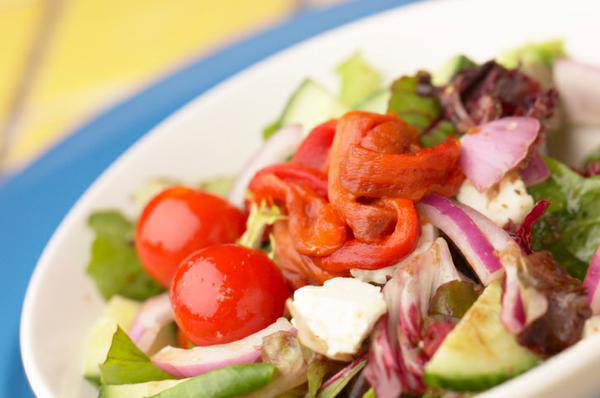
 When trying to be heart healthy and lose weight a salad can be a great choice to include as a regular part of your meal plan – either as a vegetable side or the main entrée.
However, a salad can quickly become a weight loss disaster if you make the 7 mistakes below!
Iceberg lettuce is one of the most common forms of lettuce you’ll find in grocery stores and salad bars. Unfortunately iceberg lettuce provides minimal nutrients (mostly crunchy water). Select dark green, leafy lettuce varieties, such as romaine and endive. Also, greens like spinach and arugula provide added nutrients to your salad mix.
You can afford to splurge on fresh vegetables, such as broccoli, carrots, cabbage, peppers, cucumbers, tomatoes, and mushrooms. Fresh vegetables are low in calories and rich in vitamins and minerals.
If your salad is your entrée it’s important to add some protein, such as chopped eggs, nuts and seeds, beans, or shredded meat (turkey/ham/chicken/seafood). Refer to How Much Protein Do You Need to Lose Weight? for a review of your protein needs.
Soup is often included on salad bars. Cream based soups tend to be high in calories and fat. Opt for broth based soups instead.
Croutons, sesame noodles, and bacon bits are a few common salad toppings. These topping should be used sparingly. They provide minimal nutrients and are high in calories.
Now, if you’ve avoided the first five mistakes, you don’t want to ruin your nutritious salad with a poor dressing choice. Opt for vinegar based salad dressings or low fat/calorie salad dressing if available and use sparingly. Tip: Dip your fork in a small cup of salad dressing before every bite instead of pouring the dressing on your salad. You get great flavor with every bite and use significantly less dressing.
Even if your salad bar includes unlimited trips it’s not necessary to go back multiple times – which can be very tempting. Decide in advance how many trips you’ll make and stick with your plan. Even though a well-balanced salad is a healthy choice, too much of a good thing can quickly turn bad!
All the best,
Lisa Nelson RD
The latest research published in the American Journal of Clinical Nutrition found that saturated fat is not linked to heart disease as we’ve always be told. This latest study was a meta-analysis and did not find significant evidence linking dietary saturated fat with increased risk of heart disease.
A meta-analysis combines the results of several studies completed with similar theories. In this particular analysis, 21 studies were compared in regards to dietary fat and heart disease risk. I do like meta-analysis results, because they can provide a big picture look at the overall findings. However, there are weaknesses.
Here are three known weaknesses:
Why am I sharing this information with you?
Because the results of this latest meta-analysis are interesting, but I do not recommend you throw out your olive oil and replace it with lard. It’s likely saturated fat does not deserve the “bad rap” it has received; however, that doesn’t mean excess amounts are good. Everything comes back to moderation.
Please let me know what you think by adding a comment below.
All the best,
Lisa Nelson RD
Heart Healthy Tips
http://www.hearthealthmadeeasy.com
Mark Spitz is now a retired Olympic swimmer and he turns 60 years-old on February 10th. In case you do not know of Mark Spitz, Mark won 7 gold medals at the 1972 Olympic games. His record was just recently surpassed by Michael Phelps at the 2008 Beijing Olympics with 8 gold medals.
Back in 2002, Mark was diagnosed with cholesterol levels above 300 mg/dl. He worked with his physician to lower his levels through exercise and medication. His total cholesterol was back down below 200 mg/dl within one month. Mark’s been quoted as saying “I was shocked when I was diagnosed with high cholesterol because I had no symptoms at all.” In the past few years Mark has openly discussed his history with high cholesterol and has actively encouraged continued research and awareness.
One of the 2010 national health objectives is to decrease the number of adults with total cholesterol levels >240 mg/dl. A strategy used to reach this goal is increased public awareness. The CDC has found that the number of people screened for high cholesterol and told by a health professional they have high cholesterol has increased. Before you can take action to lower cholesterol levels you have to be aware your cholesterol is an issue. If you do not know your cholesterol levels discuss with your physician to have the necessary lab work completed.
Be sure to sign-up for the free e-course How to Lower Cholesterol in 8 Simple Steps provided by dietitian Lisa Nelson at http://www.lowercholesterolwithlisa.com.
All the best,
Lisa Nelson RD
AMERICAN HEART MONTH – February is American Heart Month and to help you get on track with heart health you can access the program Heart Health Made Easy for a 25% savings.
Heart Health Made Easy: Master the Basics to Lower Blood Pressure and Cholesterol for a Longer, Healthier Life – February Savings
Purchase Heart Health Made Easy before February 28th and you’ll receive a 25% savings
The program takes you step-by-step to a lower cholesterol and blood pressure with a practical, easy to understand take action guide.
THIS PROGRAM IS RIGHT FOR YOU IF. . .
Learn more at http://hearthealthmadeeasy.com
All the best,
Lisa Nelson RD
In a previous post – Lose Weight By Slowing Down – we discussed how taking at least 20 minutes to eat your meals will increase your satiety (fullness) and prevent you from overeating. By slowing down you can promote weight loss. I wanted to share a little more information on this subject:
Greek researchers recently studies hormone levels in 17 healthy men. They had the men eat a bowl of ice cream (675 calories) in 5 minutes and then eat a bowl of ice cream in 30 minutes. When participants took 30 minutes to eat the ice cream they had higher levels of two peptides that signal satiety (fullness) even though the hunger hormone (ghrelin) was not reduced.
How quickly do you eat your meals? Do you have any good tips to share with others on how they can slow down?
All the best,
Lisa Nelson RD
1-A-Week Weight Loss Tips
http://www.weightlosswithlisa.com
A Centers for Disease Control and Prevention (CDC) report found the number of individuals in the U.S. living with elevated LDL cholesterol levels has decreased by about 1/3 between 1999-2000 and 2005-2006. These findings are based on the results of the National Health and Nutrition Examination Survey (NHANES) with just over 7,000 participants over the age of 20. According to CDC scientists the rate of high LDL levels decreased from 31.5% to 21.2%. Individuals included in the study were not taking statin medications, although self-reported use of statin medications increased from 8% to 12.4%.
This report is a good sign that more individuals are taking steps to control cholesterol levels, such as monitoring saturated and trans fat intake. However, if you are living with elevated LDL cholesterol what’s important is that you take steps to control your levels to reduce your heart disease risk. Here is a post where you can learn more about lowering LDL cholesterol:
Please share your thoughts on the study results below.
All the best,
Lisa Nelson RD
How to Lower Cholesterol in 8 Simple Steps
http://www.lowercholesterolwithlisa.com