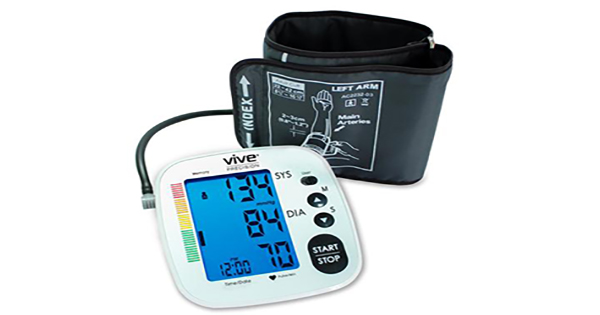
 Monitoring blood pressure at home is one step you can take to supplement clinic monitoring for a more complete representation of your typical blood pressure throughout the day.
There are a wide variety of blood pressure monitors available. The American Heart Association, American Society of Hypertension, and Preventive Cardiovascular Nurses Association all recommend upper arm devices for greater accuracy. Avoid wrist and finger monitors.
When purchasing a home blood pressure monitor, it’s important you consult with your doctor or medical supply company to ensure you select an appropriate cuff size.
Vive Precision Blood Pressure Monitor
ViveHealth.com gifted me with a Vive Precision Blood Pressure Monitor along with compensation to review this device. That being said, all opinions in this review are my own.
The Vive blood pressure monitor comes with a large, easy to read display and is battery or AC power compatible. The product I received came packaged with the four AAA batteries needed. It did NOT come with the AC adapter. Looks like it requires a standard DC V6 adapter. I do like battery operated… one less cord to wrangle and the device notifies you if the battery power is getting low.
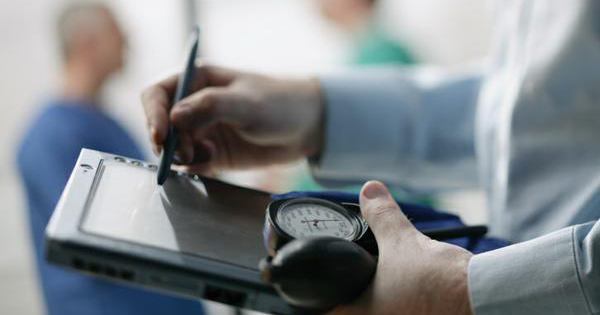 High blood pressure is diagnosed when blood pressure is consistently equal to or greater than 140 mm Hg/90 mm Hg.
 Many
Many 
![saturated-fat[1]](https://www.lisanelsonrd.com/wp-content/uploads/2016/07/saturated-fat1.jpg) It’s no wonder so many of us are confused about healthy eating. Even the nation’s dietary experts keep changing their mind about what we should eat and what we should avoid. We asked USC School of Pharmacy Research Professor Roger Clemens to help remove some of the confusion surrounding healthy fats.
It’s no wonder so many of us are confused about healthy eating. Even the nation’s dietary experts keep changing their mind about what we should eat and what we should avoid. We asked USC School of Pharmacy Research Professor Roger Clemens to help remove some of the confusion surrounding healthy fats. How many grams of fiber do you consume daily?