Heart HealthThe Yuka App: What It Gets Right (and Where to Use Your Own Judgment)

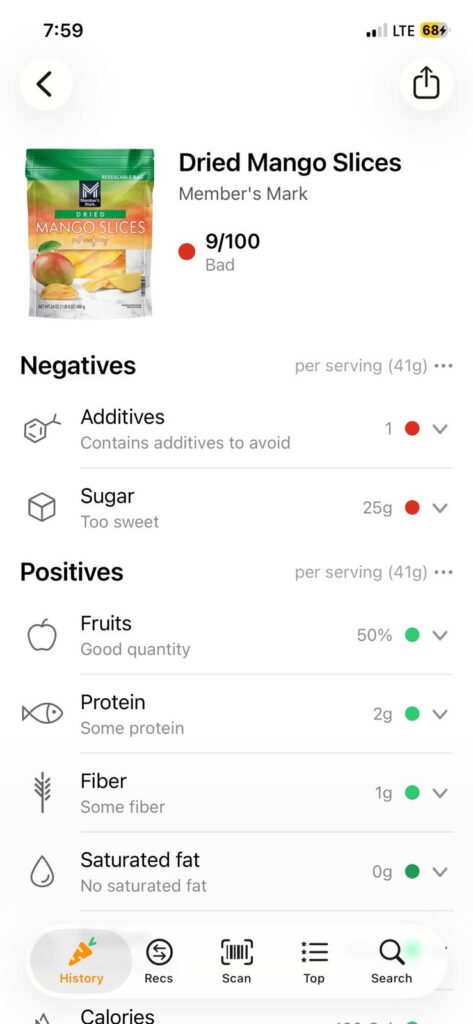
Last year I started scanning barcodes of foods when grocery shopping to try the Yuka app. When I scanned my favorite dried mangoes from Sam’s, I was very sad to see its score so low. Due to using Yuka and scanning more foods and looking closer at ingredients, I’ve changed some of my usual purchases. I actually rarely purchase dried mangoes now because it’s hard to find options in my area that don’t have all the added sugar, preservatives, and processing.
So, I wanted to share my review of the Yuka app, a free barcode scanner that rates packaged foods from 0 to 100, because it’s a simple tool that can quickly reassure you that your food choices get a green flag, or make you look twice. A low score doesn’t necessarily mean remove it from your diet. It’s a flag you can use to decide whether something deserves to stay on the shopping list as you work towards a heart-healthy diet. In this article, you’ll learn how Yuka scores your food, what the research does and doesn’t support about the additives it flags, where it oversimplifies, and how I actually use it at the grocery store.
Why This Matters for Your Heart Health
You don’t need another rule to follow at the grocery store. What you need is a way to notice things faster than you currently do, because noticing is where habit change starts.
Most of us shop on autopilot. Same brands, same snacks, same “safe” choices, without reading past the first line of an ingredient list. An app like Yuka interrupts that for about three seconds per product. A systematic review of eight studies on food-scanning apps found results tracked with how consistently people used the app, and the authors credit the self-monitoring itself: checking, logging, paying attention. Those studies measured weight loss rather than heart health, but it’s the same mechanism behind any change in how you shop. The app doesn’t do the work. The noticing does.
For heart health specifically, that noticing has a few targets. Sodium and saturated fat have the longest track record for blood pressure and LDL cholesterol, and both sit on the nutrition side of Yuka’s score. Added sugar and preservatives are the ones that tend to surprise people, because they turn up in “healthy-sounding” snacks like dried fruit, trail mix, and granola bars.
The app is a tool to tell you when to look closer and then decide.
What the Research Actually Shows
Yuka scores food on a weighted formula: 60% nutritional quality (based on the Nutri-Score system, which factors in sugar, sodium, saturated fat, calories, protein, fiber, and produce content), 30% additive risk, and a 10% bonus for organic certification. Here’s the part that surprises people: one additive Yuka classifies as high-risk caps the total score at 49 out of 100, no matter how clean everything else looks (Yuka’s methodology page lays this out). Dried mango can get hit from both directions. Added sugar pulls down the nutrition side, and the preservatives that keep dried fruit from browning land in the additive column.
What is Nutri-Score?
Nutri-Score is a European front-of-package rating system that grades a food’s overall nutritional quality using sugar, sodium, saturated fat, calories, protein, fiber, and fruit and vegetable content. Yuka uses it for 60% of a food’s score.
Is the additive penalty backed by solid evidence? Partly. The NutriNet-Santé cohort followed more than 112,000 French adults for seven to eight years. The highest consumers of certain preservatives had a 29% higher risk of hypertension and a 16% higher risk of cardiovascular disease than the lowest, and a sulfite compound was among the additives flagged. A separate review of 41 studies covering 8.3 million adults tied each additional 100 grams of ultra-processed food per day to a 14.5% higher hypertension risk and a 5.9% higher risk of a cardiovascular event.
Both are observational studies. They show an association, not proof that the additives themselves cause heart disease. It’s also worth knowing what else landed on that flagged list: ascorbic acid (vitamin C), citric acid, and rosemary extract. And 99.5% of participants had consumed at least one preservative during the study. This research is still early, and “contains a preservative” is not the same thing as “bad for your heart.”
Sulfites carry a separate, better-established concern. Per the Cleveland Clinic, dried fruit is one of the most common sulfite sources, and roughly 4-5% of people with asthma have some degree of sulfite sensitivity.
What are sulfites?
Sulfites are preservatives used to keep food from browning and spoiling. They show up most often in dried fruit, wine, and some packaged foods. Most people tolerate them without any issue.
Where Yuka gets less scientific: dietitians including Abby Langer and the RD behind Mama Knows Nutrition have flagged inconsistent scoring between nearly identical products, and nutrient-dense foods like string cheese or peanut butter penalized for a single nutrient while more processed alternatives score higher. A 2026 review from Barefoot Basil makes a similar point, estimating accuracy has slipped from around 95% to 85% as the crowdsourced product database has grown.
The value isn’t in the score. It’s in the second look it prompts.
What This Means for Your Shopping Cart
A red rating on a food means you should ask the question: what’s actually in here, and is there a version with less of it?
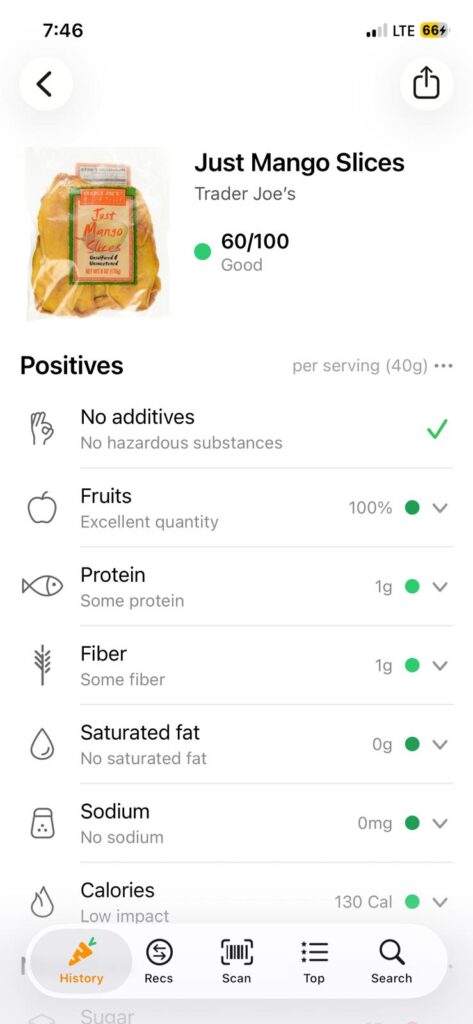
And when a score disagrees with what you already know about a food, like a cheese stick or a can of beans, you can make your own judgment call. The app is a tool to tell you when to look closer and then decide.
How I Suggest Using the Yuka App
Here’s how I actually use an app like this:
- Scan the foods you already buy regularly, not everything in the store.
- When something scores low, look at why. Sodium? Added sugar? A specific additive? That’s the useful part.
- Skip the paid version. The free one is enough to build label-reading skills and start noticing patterns.
- Treat it as one input alongside what you know about balanced eating, not the final word.
One more thing. When you trade additive-heavy convenience foods for whole ones, two nutrients are worth keeping on your radar. Magnesium is one of the minerals most people fall short on from food alone, and it matters for blood pressure. Omega-3s (fish oil) support healthy triglycerides, one of the numbers on a standard lipid panel. Both are part of the Heart Health Foundation protocol in my Fullscript dispensary if you’d like a starting point. Neither replaces the shopping habit itself. They fill gaps while you build it.
Frequently Asked Questions
What is the Yuka app and how does it work?
Yuka is a free app that scores food and cosmetic products by scanning their barcode. For food, it weighs nutritional quality (60%), additive risk (30%), and organic status (10%) into a score from 0-100.
Is the Yuka app accurate?
It’s a reasonably useful general guide, but not perfectly consistent. Nearly identical products can score differently, and reviewers report that accuracy has slipped as more user-submitted entries have been added to its database.
Why might your “healthy” snack still get a bad score?
Often it comes down to one or two ingredients rather than the food as a whole. Added sugar, sodium, or saturated fat pull down the nutrition side of the score, and a single additive rated high-risk caps the total at 49 out of 100 regardless of everything else. Dried fruit frequently hits both.
Are food additives really linked to heart health?
Large observational studies have found associations between certain preservatives and higher rates of hypertension and cardiovascular disease. These studies show a link, not proof that the additives caused the problem. The flagged lists also include everyday ingredients like vitamin C and citric acid, so the picture is still developing.
Should you avoid every product Yuka flags red?
Not necessarily. Use a red flag as a prompt to look closer at the ingredient list, not an automatic reason to put something back.
Is Yuka worth paying for the premium version?
I wouldn’t recommend it. The free version gives you enough to build real label-reading skills and shop with more awareness.
Tired of changes that don't last?
Key Takeaway
Yuka can interrupt the autopilot of habits when shopping so you stop to notice ingredient lists. It’s a nudge toward awareness that supports heart-healthy habits. The value isn’t in the score. It’s in the second look it prompts.
If you’re ready to build habits, download How to Make Heart Healthy Changes into Lifelong Habits.
All the best,
Lisa Nelson, RD
Recommended resource
The four supplements I’d start with
Food first, always. When a supplement is worth considering, my dispensary carries practitioner-grade products, most of which aren’t sold direct to consumers, with the reasoning behind each one.
View the Heart Health Foundation protocol
I may earn a commission on dispensary orders.