Lower Blood PressureHow to Reduce Sodium Intake: Lessons From a Dietitian’s Food Log

For 30 days this fall, I logged everything I ate, and my sodium averaged about 2,285 mg a day. That sits right at the 2,300 mg upper limit and well above the 1,500 mg the American Heart Association calls ideal. No single food did it. Soup, pretzels, restaurant meals and bread on the side added up.
Below I walk through how much sodium you need, what my log showed, where my sodium came from, and the small changes that make the biggest difference for blood pressure.
How Much Sodium Do You Need?
Your body needs less than 500 mg of sodium a day for fluid balance, nerve signals and muscle contraction, according to the American Heart Association. The FDA puts the average American at about 3,400 mg a day, roughly a teaspoon and a half of salt.
A teaspoon of salt holds about 2,300 mg of sodium, a full day’s upper limit. The American Heart Association sets the ideal at 1,500 mg a day for most adults, especially anyone with high blood pressure.
Sodium and salt are not the same thing. Table salt (sodium chloride) is about 40% sodium and 60% chloride. Food labels list sodium in milligrams, so that is the number to watch. And according to the AHA, more than 70% of the sodium Americans eat comes from packaged, prepared and restaurant food, not the salt shaker.
What My 30 Days of Tracking Showed
I tracked from September 27 to October 26.
- Average: about 2,285 mg a day
- Days over 2,300 mg: 9 of 30
- Days at 1,500 mg or less: 4 of 30
- Range: about 1,130 mg on my lowest day to about 4,790 mg on my highest
The trend shows more than the average does. My first two weeks averaged about 1,940 mg. My last two weeks averaged about 2,590 mg, and my five highest days all landed in that second stretch. Restaurant meals, a potluck and a can of soup drove those days.
Where My Sodium Came From
Soup
Soup showed up four times among my highest-sodium meals. A 22-ounce can of store-brand chicken noodle soup came to about 2,040 mg for the whole can, which holds about 2.5 servings. A bowl of restaurant chicken noodle soup, a bowl of chicken dumplin’ soup and a bowl of chili with beans each landed between 1,000 and 1,100 mg.
Pretzels and Snacks
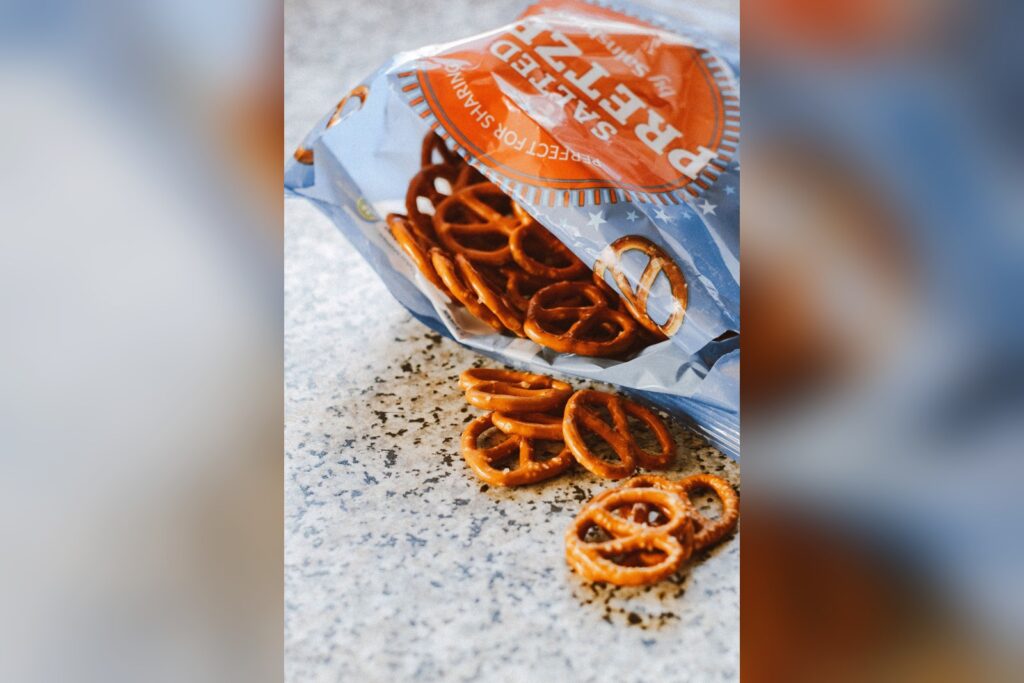
Pretzels showed up in my log on about seven days. One serving runs about 450 mg, and several times I had more than one. Over the month they added up to roughly 5,900 mg, more than two full days at the upper limit.
Eating Out, Even the “Healthy” Order
Restaurant meals came in around 1,000 mg almost every time, including the orders that looked like the safe choice. A grilled chicken salad with no dressing was about 980 mg. A Greek salad with grilled chicken was about 1,000 mg. A meatless burrito bowl with brown rice, black beans and fajita veggies was about 1,300 mg.
Restaurant sodium is hard to guess. In a study of 993 adults eating dinner at fast food chains, about 9 in 10 of those who guessed underestimated the sodium in their meal, by about 1,000 mg on average.
Bread on the Side
Three restaurant rolls came to about 750 mg. Two flour tortillas came to about 660 mg. My egg rollup, made with a tortilla, came in at 520 to 550 mg. In a CDC analysis, bread and rolls were the single largest source of sodium in the American diet, at about 7% of the total.
Beans and Cornbread
The day after my 30 days wrapped up, I made white beans with three cans of regular beans and served them with boxed cornbread muffins. Two cups of beans came to about 1,480 mg and four muffins to about 1,280 mg, roughly 2,760 mg for two foods. My log assumed the beans were drained, and I didn’t drain or rinse them, so the real number for the beans was likely higher.
Rinsing regular canned beans cuts their sodium by about 40%, and it costs nothing.
I didn’t want to pay the extra cost for no-salt-added beans, and no salt added wasn’t available in the store brand. It’s a reminder for next time that it’s a better decision to spend the extra for the no-salt-added version of beans, or make them differently by draining and rinsing them.
Rinsing regular canned beans cuts their sodium by about 40%, and it costs nothing. Food scientists at the University of Tennessee found that draining canned beans cut sodium by about 36%, and draining plus rinsing cut it by about 41% (Today’s Dietitian).
The three minerals that lower blood pressure
How to Limit Sodium Intake for Blood Pressure
Sodium holds water in your bloodstream, and more fluid means more pressure on your artery walls. Sodium also works in balance with potassium, which I cover in Sodium and Potassium: Are You Getting Too Much or Too Little?
A 2023 study in JAMA put 213 adults aged 50 to 75 on one week of very low-sodium eating and one week of high-sodium eating. Compared with the high-sodium week, systolic blood pressure (the top number) was about 8 points lower on the low-sodium week, and about 3 out of 4 people saw a drop. The drop was about the same for people who took blood pressure medication and people who did not.
What is systolic blood pressure?
Systolic blood pressure is the top number in a reading, the pressure in your arteries when your heart beats. The bottom number, diastolic, is the pressure between beats. The American Heart Association considers a reading under 120/80 normal.
That was a strict, closely controlled diet. In everyday life, plan on 4 to 6 months for changes in what you eat to show up fully in your blood pressure. Lower sodium works alongside whatever your doctor has prescribed.
Small Changes That Add Up
- Drain and rinse canned beans. That alone takes out about 40% of the sodium.
- Buy no-salt-added when the price works. When it doesn’t, or the store brand doesn’t carry it, rinse.
- Split the can of soup. Have half and save the rest for the next day.
- Portion snacks into a bowl. At about 450 mg a serving, pretzels eaten from the bag are easy to undercount.
- Read the % Daily Value. 5% or less per serving is low and 20% or more is high. My post on how to read food labels walks through the rest of the label.
- Ask for sauce and dressing on the side when you eat out, and skip or limit the bread basket.
What is the % Daily Value?
The % Daily Value on a Nutrition Facts label shows how much of a nutrient one serving gives you, compared with the daily amount set by the FDA. For sodium, 100% is 2,300 mg, so a serving listed at 20% has about 460 mg.
The hard part is noticing. A few days of logging what you eat, sodium included, shows you which of these changes matter most for you. For more ways to bring your numbers down, see 8 lifestyle habits that lower blood pressure and LDL cholesterol and how to move more without a workout.
If you want help putting the food side of blood pressure and cholesterol into a real week, that is what my program Heart Health Made Easy is for: seven lessons over seven weeks.
Frequently Asked Questions
What’s the difference between low sodium and no salt added?
Under FDA label rules, “low sodium” means 140 mg or less per serving. “Reduced sodium” means at least 25% less than the regular version, which can still be high. “No salt added” means no salt was added during processing, though the food can still contain sodium naturally, so check the Nutrition Facts label.
Is sea salt lower in sodium than table salt?
Not by weight. Sea salt and table salt are both about 40% sodium. Some sea salts have larger crystals, so a teaspoon may hold a little less, but gram for gram the sodium is the same.
How do I reduce sodium when eating out?
Ask for sauces and dressings on the side, choose grilled or baked over breaded, and skip or limit the bread basket. Chain restaurants with 20 or more locations are required to have full nutrition information, including sodium, available on request, so you can check before you order.
Key Takeaway
In my 30-day log, no single food pushed my sodium over the limit. Soup, snacks, restaurant meals and bread did it together, and the fixes were just as ordinary: rinse the beans, split the soup, portion the snacks and ask for the sauce on the side.
All the best,
Lisa Nelson, RD
Recommended resource
Where I send people for supplements
Food first, always. When a supplement is worth considering, the front of the bottle is marketing and the supplement facts panel is the actual content. Two bottles at the same price can differ by half in what they deliver.
My dispensary carries practitioner-grade products, most of which aren’t sold direct to consumers, with the reasoning behind each one.
I may earn a commission on dispensary orders.