7-lesson program · Instant access
Heart Health
Made Easy
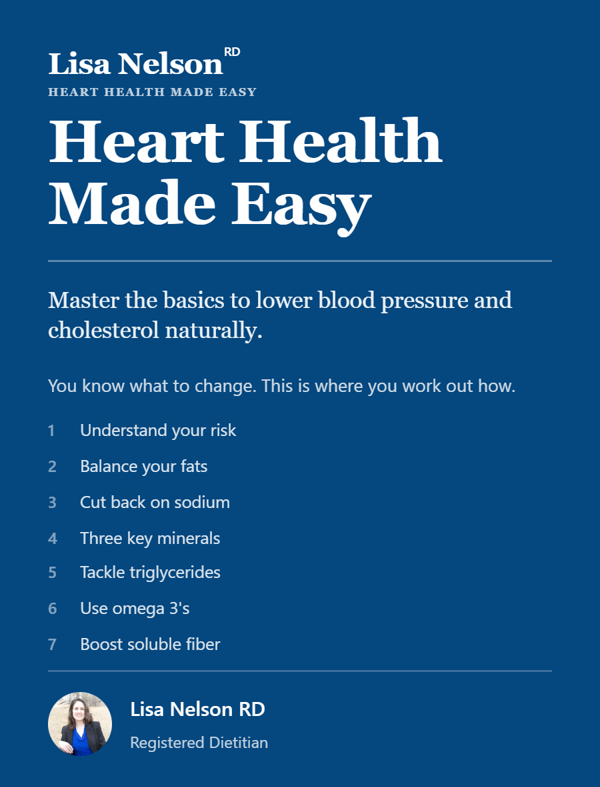
You know what to change. This is where you work out how.
A 7-lesson program for lowering cholesterol and blood pressure through food, from a Registered Dietitian who has been doing this since 1999.
8-week unconditional money-back guarantee. Instant access.
The problem isn’t information
You can find out that soluble fiber lowers cholesterol in about four seconds. What’s harder to find is how much you need, which foods actually contain it, how to tell from a label, and what to do about the fact that you eat out three nights a week.
That’s the gap between knowing and doing, and it’s where most people stall.
Heart Health Made Easy closes it. Every lesson ends with an activity that uses your kitchen, not a hypothetical one.
In Lesson 1 you check off your own risk factors, then work out which ones you can actually change. In Lesson 2 you do a Fat Inventory: two columns, the foods you eat weekly on one side and the swap on the other. Bacon to Canadian bacon. Pork ribs to pork loin. Ground beef to beans. You mark what you actually buy, and you leave with a shopping list.
You’re not reading about heart health. You’re going through your own diet, one lesson at a time.
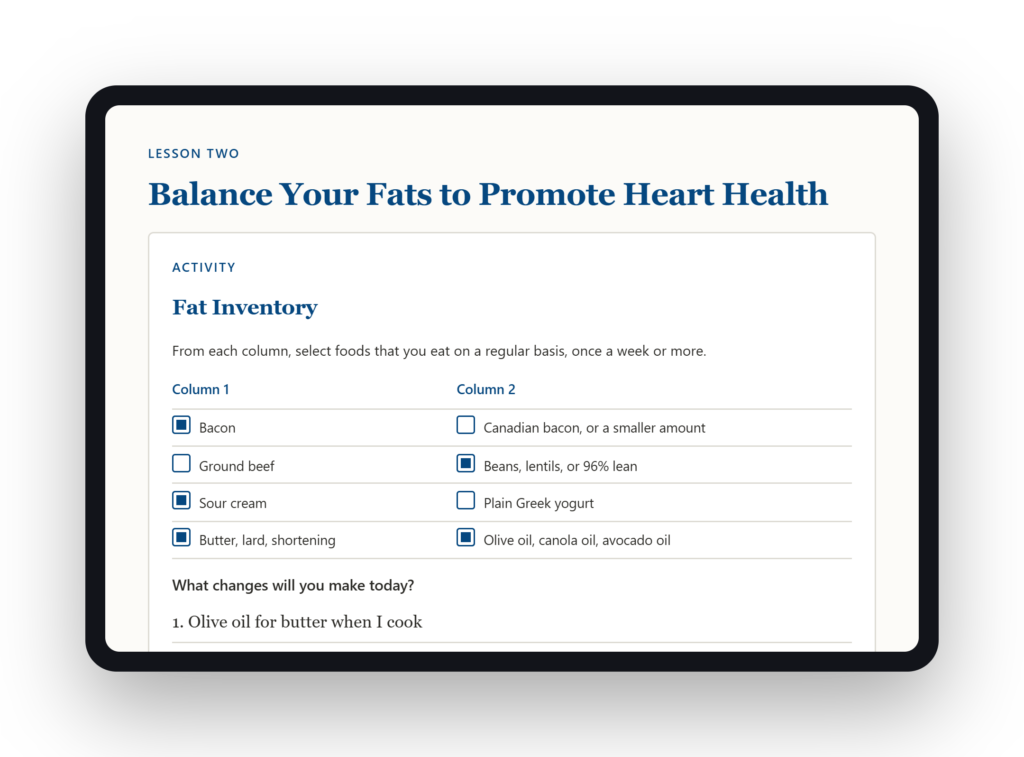
A page from Lesson 2.
I have the same problem you do
My cholesterol has been borderline high since my early twenties. For years it sat between 200 and 220, and I was healthy and active the whole time. Genetics doesn’t care much about that.
My grandmother died of a heart attack at 69. One grandfather died of a heart attack. Another didn’t recover from quadruple bypass surgery.
So this isn’t a subject I picked up because it seemed like a good market. I went into nutrition partly to work out what to do about my own numbers, and I’ve been managing them with the same steps that are in this program ever since.
That’s also why the program is built the way it is. Reading about soluble fiber never changed my labs. Going through my own kitchen did. Every lesson here ends with an activity because that’s the part that actually worked.
It’s in the 160s now, and it has held there for years.

Lisa Nelson, RD
Registered Dietitian since 1999 · Licensed Nutritionist in South Dakota
Seven lessons
Ten reference guides
The lessons teach you. These are what you keep coming back to.
One lesson a week
I recommend no more than one lesson per week. Change is hard, and the slower you go the more likely it sticks.
Each lesson gives you the information, then hands you something to do with it. You work at your own pace, in your own kitchen, with the food you actually buy.
You get an interactive workbook you fill in as you go, plus a PDF for reading offline or printing. Both are yours to keep. No login, no expiring access, nothing to schedule.
“My cholesterol was high at 271 with an LDL of 220, HDL 51, and triglycerides of 155. Over 3 months I lost about 30 pounds and lowered my cholesterol to below 200, my LDL is down to 132, HDL up to 54, and triglycerides dropped to 47. I feel the best I have in years.”
Dennis Daniel, Atmore, AL“I lowered my cholesterol from 232 to 161 in just 8½ weeks. My triglycerides went from 447 to 131 as well.”
Pamela Webster, 44, Cayman Islands“I reduced my LDL cholesterol from 210 to 122. Also increased my HDL. When my doctor saw the results she assumed she had put me on statins because she couldn’t believe I had lowered it that much.”
Linda MaxwellIndividual results vary. These are real reports from people who used this material, not a prediction of your results.
This is a fit if:
- You’ve been diagnosed with high cholesterol or high blood pressure and want to start with food
- You want specifics, not “eat better and exercise more”
- You’re willing to work at it over a couple of months rather than looking for a quick fix
- You want something concrete to bring to a conversation with your doctor
It’s not a fit if:
- You’re looking for a supplement protocol. Supplements come after diet, not instead of it.
- You want results this week. Cholesterol takes 4 to 6 weeks to respond to dietary change, and blood pressure usually longer.
- You’re hoping to stop a prescribed medication. That’s a decision for you and your doctor, based on your labs.
Everything above, plus:
Every target number, the label-reading order, the swaps that matter most, and the questions to ask your doctor. Two pages, designed to print and keep where you cook. This is what you reach for six months from now when you are standing in an aisle and cannot remember whether 3 grams of fiber per serving is good.
Eight weeks, no conditions
Use the program for eight weeks. If it isn’t what you expected, or it isn’t useful to you, email me and I’ll refund your $47.
You don’t have to explain why, return anything, or prove you tried. There’s no condition on the refund.
I’d rather refund someone than have them feel stuck with something that didn’t help.
Questions
The free course tells you what to change. This tells you how much, which foods, what to look for on a label, and what to do when you’re eating out. It also includes the activities that get you applying it, and the reference guides, including the one on the labs beyond a standard panel.
“I was able to find much of the same info online, although it is mostly in scattered bits as opposed to all in one place like what you have offered. However, it’s difficult to know which info to trust, some is actually contradictory and confusing. Having all of the data I needed, in one location, from someone who obviously knows what they’re talking about and isn’t trying to sell me the latest ‘miracle’ supplement is exactly what I was looking for.”
Tim W., Seattle, WANo. Lesson 2 is mostly about swaps rather than removals, and there’s a full guide to recipe substitutions and one on dining out. The program is built around eating differently, not eating less.
Yes. Medication addresses the number. Diet addresses what’s driving it, and the two aren’t in competition. Any change to your medication is a decision for you and your doctor, based on what your labs show.
Cholesterol typically takes 4 to 6 weeks to respond to dietary change. Blood pressure usually takes longer, often 4 to 6 months for gradual changes. Anyone promising faster than that is selling you something.
One lesson a week, and the activities are things you do while you’re already cooking or shopping. It’s built to fit what you’re doing anyway rather than add to it.
An interactive workbook you open in your browser and fill in as you go, with your answers saving automatically. You also get the full program as a PDF for reading offline or printing, plus the quick reference card. All three are yours to keep. No login, no expiring access.
The deadline isn’t mine
There’s no countdown on this page. The deadline is your next lab appointment.
Cholesterol takes 4 to 6 weeks to respond to dietary change, and blood pressure takes longer. If your next blood draw is three months out, starting this week means you’ll have something to show for it. Starting in a month means you probably won’t.
Start with Lesson 1
You don’t have to work out where to begin or which advice to trust. The order is already set. One lesson a week, and you’ll have been through your whole diet by the end.
8-week unconditional money-back guarantee.
Lisa Nelson
Registered Dietitian since 1999 · Licensed Nutritionist in South Dakota
The information shared by Lisa Nelson RD is for educational purposes and is intended to support, not replace, the professional medical advice you receive from your doctor. You should always consult with your physician before starting a fitness regimen, adding supplements to your diet, or making any other changes that can affect your medications or treatment plan. This information is not to be used to diagnose or treat any condition. Lisa Nelson, RD is not liable for how you use and implement the information you receive. Lisa Nelson RD may recommend products, services, or programs as an affiliate.
Terms and Conditions Privacy Policy Disclaimer
PO Box 534, Custer, SD 57730 | 406-600-7783
Copyright © 2007-2026 Lisa Nelson RD LLC. All Rights Reserved.