
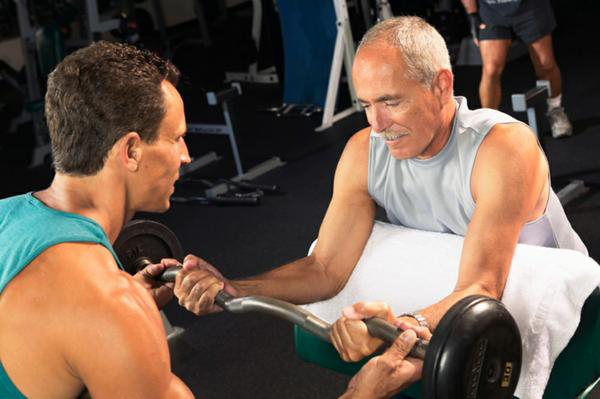
Lifting weights can cause a temporary, but dramatic blood pressure rise. Systolic blood pressure can increase up to 350-400 mm Hg and diastolic blood pressure to 150 mm Hg, even if your blood pressure is typically a healthy level of 120/80 or less.
Long-term high blood pressure is linked to arterial endothelial dysfunction. The endothelium is the inner lining of your artery walls. Endothelial dysfunction can result in the hardening of artery walls. Researchers have been monitoring the effects of short duration rises in blood pressure, such as what occurs during strength training, to determine the effect on endothelial function. It has been determined that acute rises in blood pressure impair endothelial function in untrained individuals, and regular resistance training helps protect against vascular dysfunction.
Continue reading
By now you know being heart healthy and losing weight go hand-in-hand with physical activity. If you want to lose weight and keep it off, you have to be regularly active. If you want to lower triglycerides you have to be active. If you want to raise HDL you have to be active.
The Health and Human Services Department sets physical activity guidelines after reviewing a good decades worth of research related to physical activity and health.
Continue readingIt’s very possible your MD orders lab work and you have no idea what or why you’re having blood drawn. Well, let’s clear up the confusion when it comes to your cholesterol labs.
The terms “lipid panel”, “lipid profile”, and “lipoprotein profile” are used interchangeably to order the same set of labs. To make reading this easier, I’m going to use “lipid profile” from here on out.
“Lipid” is simply a medical term for “fat”. A lipid profile measures fatty substances in your blood. Cholesterol is one type of fat.
When you eat food containing cholesterol or when your body produces cholesterol and releases it into your bloodstream, the cholesterol will attach to a protein. This package of cholesterol plus a protein is called a lipoprotein (lipid or fat plus protein). A lipid profile measures lipoprotein levels in your blood.
Lipid profiles include five components:
LDL – “bad” cholesterol
LDL (low-density lipoprotein) cholesterol carries mostly cholesterol, some protein, and minimal triglyercerides throughout your circulation. LDL should be less than 130 mg/dL, ideally less than 100 mg/dL.
VLDL – “bad” cholesterol
VLDL (very low-density lipoprotein) cholesterol contains minimal protein and mainly transports triglycerides. VLDL should be less than 40 mg/dL.
Triglycerides
Triglycerides are a type of fat in the blood, not a type of cholesterol. Triglycerides are frequently used to estimate VLDL (“bad”) cholesterol. Here’s the calculation: triglycerides divided by 5 equals VLDL cholesterol. Triglycerides should be less than 200 mg/dL, ideally less than 150 mg/dL.
HDL – “good” cholesterol
HDL (high-density lipoprotein) cholesterol removes cholesterol from your bloodstream and carries it back to the liver. I like to think of HDL as a vacuum cleaner, picking up cholesterol LDL leaves behind in your arteries, the more HDL the better. HDL should be greater than 40 mg/dL, ideally greater than 60 mg/dL.
Total cholesterol
Cholesterol is essential to bodily functions, such as building cells and producing hormones. However, too much cholesterol will build up on artery walls, form a plaque, and potentially “plug” the artery resulting in a heart attack or stroke. Total cholesterol is calculated from the above components (Total cholesterol = HDL + LDL + VLDL). Total cholesterol should be less than 200 mg/dL.
Do you see how if you only know your total cholesterol, you only have one piece of the lipid profile?
Now, sometimes your results will include ratios or a risk score. Here’s an explanation of what those numbers mean.
Risk Score
A risk score is based on you lipid profile results, sex, age, family history, and various other risk factors. If you have a high risk score for heart disease, it’s best to speak with your MD to evaluate your risk score.
Cholesterol:HDL Ratio
You want a low ratio of cholesterol to HDL. A ratio lower than 4.5 is good, but 2 or 3 is best. You can calculate your cholesterol to HDL ratio by dividing total cholesterol by HDL. For example, your total cholesterol is 195 and your HDL is 55. 195 divided by 55 equals a ratio of 3.5.
It’s actually not your total cholesterol that has the greatest impact on your heart disease risk. The ratio of total cholesterol to HDL is a critical factor. If your total cholesterol is less than 200, but your ratio is 5, you are still at increased risk for developing heart disease.
LDL:HDL Ratio
This ratio compares the amount of bad (LDL) cholesterol to your good (HDL) cholesterol levels. You want a ratio less than 3.5, ideally less than 2.5. To calculate your ratio, divide LDL by HDL. For example, your HDL is 55 and LDL is 100. 100 divided by 55 equals a ratio of 1.8.
Triglyceride:HDL Ratio
A low ratio of triglycerides to HDL is best, ideally less than 2. To calculate your triglyceride to HDL ratio, divide your triglycerides by your HDL. For example, your triglyceride level is 200 and your HDL is 55. 200 divided by 55 equals a ratio of 3.6.
Lipid profiles are commonly ordered to assess your heart disease risk. Your doctor or dietitian will use the results to determine the best treatment to reduce your risk.
A lipid profile is beneficial, because you know your “good” cholesterol level and “bad” cholesterol levels. The interventions that work best to raise HDL and lower LDL differ, so knowing all your numbers helps you make the most effective changes.
You’re probably wondering why a lipid profile isn’t always ordered versus simply checking your total cholesterol (and possibly HDL). Cost and time always play a part and if your risk for heart disease is low, then a quick and less expensive screening makes sense. If you are at increased risk, a more complete assessment (lipid profile) may be more appropriate. Everyone’s situation is unique, so it’s best to discuss what’s right for you with your MD.
Now, to receive regular heart health and weight loss tips from dietitian Lisa Nelson, subscribe to The Heart of Health today!
All the best,
Lisa Nelson RD
Special Report – Article Excerpt:
Stop Wasting Money – Take Control of Your Health
Ensure your success with lowering
cholesterol, controlling high blood pressure,
and weight loss by knowing how to achieve change.
Did you come across a treadmill for a great discount price and decide – I need to exercise more; I’m not going to find a better price, why not? So, you now have this piece of equipment in a corner of your living room or bedroom collecting dust or acting as an expensive clothes rack.
Why is it that your good intentions led no where? Sure, that first week or two you hopped on several times, but then your progress came to a screeching halt. Well, you may not have had everything in place to be successful. You need to make sure all your “ducks are in a row” to ensure your success. If you jump from Contemplation into Action you are skipping the critical Preparation phase. Huh? You will begin to understand what I mean as you read on.
For the purpose of this article, I will focus on the critical action step. The goal I use is increasing physical activity. You can use the Stages of Change model to work on any area you are trying to change, such as eating habits to lose weight, lowering cholesterol levels, and/or controlling high blood pressure.
The Stages of Change model was first developed by psychologists James Prochaska and Carlo DiClemente in the late 1970’s. They focused on changing addictive behaviors, specifically smoking. The Stages of Change model identifies the phases we go through when we change our habits. The five stages are called – 1. Pre-contemplation, 2. Contemplation, 3. Preparation, 4. Action and 5. Maintenance. Tailoring your actions based on the stage you are in will propel you forward.
No need to waste time dwelling on the science behind the method. Just know it has been proven a useful tool. Now, let’s dive into how you can use it to your benefit.
In this stage you are performing the behavior regularly, but for less than 6 months. This means you have established a plan of action and have implemented that plan. You are actively modifying your behaviors, experiences, and environment to overcome obstacles and achieve success. The action phase is the most difficult and requires a considerable commitment of time and energy. Change does not happen overnight. It will take persistence for a new behavior to become an established habit.
The following four strategies are used to move through this stage of change:
Counter-conditioning
Substitute alternate positive behaviors for the negative behavior. It can take up to 30 days for a new behavior to become a habit. Be aware of this and put safety guards in place. Stick with your action plan and continue to replace old sedentary behaviors with new physically active ones. You may feel some loss. You actually miss your old behaviors. These behaviors are like old friends you felt comfortable with and change moves you out of your comfort zone. Review your reasons for wanting to be physically active and the long-term benefits you will gain if you stick with your plan.
Reinforcement Management
Change the events that determine or sustain the problem behavior. Reward yourself for achieving your goals, such as a new outfit, book, or running shoes. Recognize your progress and reward yourself. This will provide you with an incentive to stick with your new plan.
Helping Relationships
Turn to your support system. Don’t get overconfident and think you do not need family and friends behind you. Keep them in the loop with the progress you’ve made and identify new ways they can help you move towards your goals. Now is a time to consider signing a “contract” with yourself to reinforce your commitment to change. Have your family and friends be witnesses!
Stimulus Control
Be aware of triggers for reverting to your old habits. What safety mechanisms can you put in place to negate these triggers? Start replacing old behavior triggers with something positive. For example, place your goals where you will see them daily – like the refrigerator. Keep gym shoes by the front door. Create reminders at work, such as tennis shoes under your desk for a lunch time walk. Always be on the lookout for stumbling blocks and be prepared to brainstorm ways to overcome the hurdles.
You are doing great! Maintenance is just around the corner.
Bottom Line:
During the action phase, you make your goals a reality. Now is not a time to get cocky. Hurdles will frequently pop up and you need to be ready with strategies to overcome them. You will have some bad weeks. Step back, evaluate what is keeping you from regular activity, and figure out a solution. It may take some trial and error before you find the right solution for you. Now about that treadmill – you have it and it is dust-free!
Tackling change is hard and determining exactly what steps you need to take can be confusing. By recognizing that change has identifiable steps and strategies, you can use this knowledge to move forward and achieve your goals!
All the best,
Lisa Nelson RD
Be Heart Healthy and Lose Weight
I was recognized this month by Constant Contact as a business with a successful email marketing campaign. Here’s the write up:
Email Marketing Success Story
Healthy and Happy Readers: A Constant Contact customer discusses the value of editorial planning
eNutritionServices
List Size: 725
Open Rate: 35%
Website: https://www.lisanelsonrd.com
Ask Lisa Nelson and she’ll tell you she was “blessed with crummy genetics”: Her family has a strong history of heart disease and she has a personal cholesterol level that has hovered around 200 since her early twenties. Both factors inspired Lisa, a registered nutritionist, to start her own business, eNutritionServices, which empowers people to take the necessary steps to promote a long, heart-healthy life. Since June 2007, she has provided guidance on how to lower cholesterol and blood pressure naturally and lose weight in a healthy way. Clients receive education, support, and coaching via Lisa’s Heart of Health email newsletter, online courses, special reports, and online coaching.
The Heart of Health email newsletter began in May 2008. Each issue features an article about one of three distinct topics — cholesterol, blood pressure, or weight loss — but in an effort to include all interested readers, Lisa also includes a “Take Action” section with tips on another of the subjects. For example, if the feature article is about cholesterol, the action tip might be about weight loss. “To stay on track, I have an electronic schedule outlining my newsletter topics several months in advance,” Lisa explains. In every issue, Lisa also asks readers for feedback about their biggest health struggles, and takes advantage of the opportunity to better connect with her readers by sending a personal email directing the person to an article or product that addresses his or her concern.
By redirecting traffic from her newsletter to her website and following the click-through rates, Lisa is able to see which specific items readers are most interested in. She can then rotate the products/services she offers on the site appropriately, and can also tailor the newsletter to better suit her readers’ interests. In addition, she leverages the newsletter to collaborate with colleagues on joint ventures, and has used the newsletter to gain greater exposure for her business. For example, she now writes an “Ask the Expert” column for another health website, and even uses the questions she’s asked there to generate articles for her own newsletter. These results have made Lisa optimistic about eNutritionServices’ future prospects: “I trust email marketing will lead me to the successful online practice I am working towards,” she says.
All the Best,
Lisa Nelson RD